


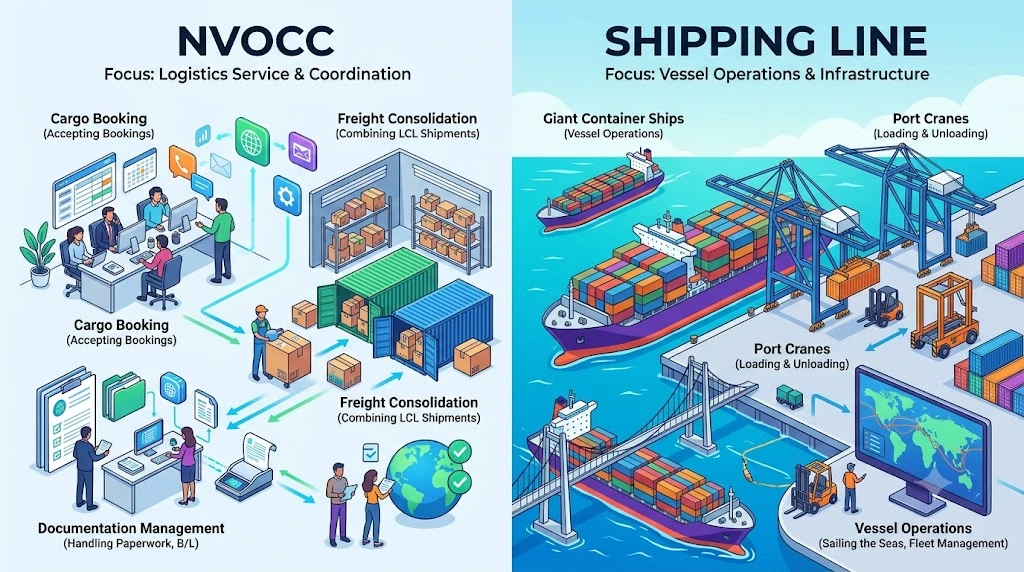
Businesses involved in managing or dispatching their cargo internationally are likely to come across or book both NVOCCs and Shipping Lines for their distribution leg or legs. However, these entities may have different obligations under a contract, have a distinct organizational setup, and/or utilize different assets, such as vessels, to fulfill the contract.
The difference between the two lies primarily in the fact that:
A shipping line operates vessels to carry goods by sea, while an NVOCC provides ocean freight services but doesn’t operate vessels. Knowing the difference between an NVOCC and a Shipping Line is essential for importers and exporters considering either as a carrier for their shipments and the accompanying documents such as the House Bill of Lading.
NVOCC Vs Shipping Line: What Is the Basic Difference?
The basic difference between an NVOCC and a Shipping Line is that the latter operates the vessels, while the former doesn’t. A shipping company, also referred to as a Vessel Operating Common Carrier, or VOCC, owns or charters vessels to carry goods by sea. An NVOCC, which stands for Non-Vessel Operating Common Carrier, is an intermediary that purchases space from shipping companies and resells it to shippers under a contract of carriage.
It is worth noting that an NVOCC acts as a carrier to the shipper and a shipper to the actual vessel operating company.
NVOCC Vs Shipping Line: Comparison Overview
The table below provides a brief overview and further insight into the main differences between an NVOCC and a Shipping Line.
|
Factor |
NVOCC |
Shipping Line |
|
Vessel operation |
Doesn’t operate vessels for international transportation |
Operates vessels for international transportation |
|
Customer relationship |
Contracts with shippers for international transportation services |
Contracts directly with customers for carrier services (VOCC) |
|
Carrier relationship |
Contracts with vessel operating carriers |
Operates its vessels |
|
Bill of Lading |
Can issue its Bill of Lading |
Issues carrier Bill of Lading |
|
Booking |
Books cargo with a carrier |
Operates its own service/network |
|
Service model |
Can offer consolidated/network-based solutions based on its operations |
Offers vessel-based carrier services |
What Is an NVOCC and How Does It Work?
An NVOCC, or Non-Vessel Operating Common Carrier, is a carrier that doesn’t operate or own vessels. Instead, an NVOCC contracts with vessel-operating companies to reserve space on regular voyages to provide transportation services to shippers. Non-Vessel Operating Common Carriers do not own or operate any vessel, but they issue a Bill of Lading to the shipper and are responsible for the transportation of the goods by sea.
Some NVOCCs provide consolidated shipment services on a Less-than-Container-Load (LCL) basis to combine multiple shippers’ cargo into a Full Container Load (FCL). An NVOCC’s operations, networks, and range of services depend on the carriers it has contracted with.
What Is a Shipping Line and How Does It Work?
A Shipping Line operates the vessels used to carry goods by sea. A shipping company, also referred to as a Vessel Operating Common Carrier (VOCC), owns or leases the vessels to carry goods by sea regularly. A shipping line’s network, schedules, and other operations are determined by the vessels it operates.
When a shipper books directly with a shipping line, the company can reserve space on a specific vessel and carrier. The VOCC provides transportation services by sea, including documentation, and has direct control over its vessels’ operations.
NVOCC Vs Shipping Line: How Different Is the Booking Process?
The booking process depends on the entity the shipper has selected to make the transportation arrangements.
- When booking with an NVOCC: The shipper provides the NVOCC booking information. The NVOCC determines the best carrier to utilize based on its own contracts, and books the space with the chosen carrier. The shipper can get quotes from several NVOCCs, each of which may book space with different Shipping Lines.
- When booking directly with a Shipping Line: The shipper provides the carrier with its booking information. The VOCC books the space on one of its own vessels following the shipper’s instructions.
The booking process can be more complicated when done directly with a carrier. Although shippers have more control over the process, the communication and coordination are more involved as opposed to booking with an NVOCC. In addition, when booking directly with a carrier, the shipper has less flexibility in terms of vessel options.
House Bill or Master Bill? Why Does the Bill of Lading Matter?
The difference in documentation is another critical difference between an NVOCC and a Shipping Line. In short, the contractual relationship determines which entity issues the Bill of Lading (B/L).
- Master Bill of Lading (MBL): A shipping line issues the Master Bill of Lading to an NVOCC or a commercial shipper. The MBL indicates the shipper and the consignee and serves as evidence of the contract of carriage between the shipper and the carrier. If an NVOCC is involved, the MBL evidences the contract between the NVOCC and the Shipping Line. In this case, the MBL lists the NVOCC as the shipper and the NVOCC’s destination agent as the consignee. If the commercial shipper books directly with the Shipping Line, the MBL lists the commercial shipper and their receiver.
- House Bill of Lading (HBL): An NVOCC issues the House Bill of Lading to a commercial exporter. This document confirms the contract of carriage between the exporter and the NVOCC carrier. The HBL lists the actual exporter as the shipper and the actual importer as the consignee.
Overview of HBL and MBL in an NVOCC Arrangement
The table below summarizes the main differences between an MBL and an HBL in an NVOCC arrangement.
|
Feature |
House Bill of Lading |
Master Bill of Lading |
|
Issuer |
The NVOCC |
The Shipping Line (VOCC) |
|
Listed shipper |
The commercial exporter |
The origin NVOCC |
|
Listed consignee |
The commercial importer |
The destination NVOCC agent |
|
Contractual tie |
Between the exporter and the NVOCC |
Between the NVOCC and the Shipping Line |
Not every NVOCC shipment involves a House Bill of Lading. In some cases, a commercial shipper can receive a Master Bill of Lading directly from the carrier. Certain countries require a different set of documents or variations of the HBL and MBL. The documents and their format depend on the contractual relationship and the customs regulations in the country of destination.
NVOCC Vs Shipping Line: Why Is Pricing Different and Why Is It Important?
The freight rates don’t necessarily indicate which entity is more cost-effective. The rates set by an NVOCC and a Shipping Line depend on several factors.
- The rates set by an NVOCC depend on the company’s own expenses, such as the tariffs it pays to the carriers it utilizes.
- The rates set by a Shipping Line depend on the carrier’s expenses, such as fuel, crew, vessel maintenance, and more.
- The rates can vary significantly depending on the cargo’s type and weight, the services required (Full Container Load or Less-than-Container-Load), and the trade lane.
- An NVOCC may have access to more competitive rates due to its ability to consolidate cargo.
- An NVOCC can provide more competitive rates for smaller shippers than a carrier can for larger shippers.
However, it’s essential to consider more than just the rate when selecting an entity for the transportation of goods. For instance, an NVOCC may charge extra for documentation or handling at the destination. In addition, the freight rate is only one component of the shipping cost. The total cost depends on the port charges, carrier documentation fees, and additional costs.
Where Does an NVOCC Offer More Service Flexibility?
Flexibility is one of the main reasons businesses opt for an NVOCC instead of a Shipping Line. An NVOCC can offer more flexibility in terms of:
- Carrier options: An NVOCC can provide several options based on the carriers it has booked with. If one carrier doesn’t serve a specific destination or has limited transshipment options, another carrier may be available.
- Available sailing options: An NVOCC may have access to different sailing options, including varying transshipment options, depending on the underlying carrier networks.
- Cargo consolidation: An NVOCC can consolidate Less-than-Container-Load (LCL) shipments into a Full Container Load (FCL) to reduce costs.
- Overall coordination: An NVOCC can offer end-to-end coordination and flexibility in terms of documentation, compared to a Shipping Line, which operates on a global level and offers standardized documentation.
It is important to note that an NVOCC can only provide the aforementioned service flexibility if it has contracted with a particular Shipping Line or set of Shipping Lines.
Who Handles What? Comparing Operational Responsibilities
The responsibilities of an NVOCC and a Shipping Line differ significantly.
An NVOCC:
- Typically handles the shipper’s ocean transportation contract.
- Is responsible for overall booking coordination.
- Issues the shipper’s House Bill of Lading.
- Coordinates with the carrier.
- Handles the consolidation of cargo, if any.
- Manages the documentation, including the presentation to the carrier.
- Processes the payment to the carrier, if any.
A Shipping Line:
- Typically handles the actual vessel operation.
- Manages the vessel’s scheduling.
- Oversees port operations.
- Manages overall vessel capacity.
- Books space with an NVOCC or a commercial shipper.
- Issues the Master Bill of Lading.
- Performs actual transportation by sea under the service contract.
- Provides carrier documentation to an NVOCC or commercial shipper, if any.
NVOCC or Shipping Line? What Should an Importer or Exporter Evaluate?
When evaluating the options in front of them, importers and exporters should consider several factors.
A shipper, whether an importer or an exporter, should analyze the following:
- Shipment’s requirements: Does the business need FCL or LCL?
- Shipment’s weight/volume: How many TEUs does the business need to ship?
- Service level: Does the business need an entity that serves specific origin(s) and destination(s)?
- Contract structure: Who is responsible for the cargo during transportation?
- Rate structure: Does the business compare the entire price (port-to-port or door-to-door) or just the ocean freight rate?
- Communications: Does the business need someone to act as the single point of contact, or is the shipper comfortable booking directly with the carrier?
When Does Working With an NVOCC Make More Sense?
Working with an NVOCC makes more sense for:
- Shippers that seek to leverage the capacity of a carrier without making a long-term, large-volume commitment.
- Importers and exporters that need LCL consolidation services.
- Businesses that prefer having a single logistics partner, rather than dealing with multiple carriers.
- Shippers that seek to optimize their trade lanes and take advantage of a wide network of options and carriers.
- Exporters and importers that seek to benefit from the flexibility an NVOCC can provide, including documentation.
When Does Working With a Shipping Line Make More Sense?
Working with a Shipping Line makes more sense for:
- Large-scale shippers that can commit to a high volume of TEUs and negotiate directly with the carrier.
- Shippers that have developed longstanding relationships with a particular carrier.
- Shippers that operate standardized, port-to-port FCL services and have little need for other services.
- Businesses that prefer to deal directly with the carrier and manage their logistics in-house.
NVOCC vs Shipping Line: A Practical Comparison for Indian Importers and Exporters
When it comes to the intricacies of international trade, choosing between an NVOCC and a Shipping Line can be equally challenging for Indian importers and exporters. The comparative summary below outlines the main aspects to consider.
|
Decision Factor |
NVOCC |
Shipping Line (VOCC) |
|
Vessel operation |
No |
Yes |
|
Contract with shipper |
Yes |
Yes |
|
Carrier relationship |
Contracts with vessel operators |
Operates its vessel services |
|
Bill of Lading |
Can issue its B/L |
Carrier B/L |
|
Carrier choice |
Depends on network/contracts |
Own operating network |
|
Consolidation (LCL) |
May be available |
Depends strictly on carrier service |
|
Pricing structure |
Depends on contracts and services |
Depends on carrier rates and market conditions |
|
Best fit |
Depends on shipment requirements |
Depends on shipment requirements |
How Total Transport Can Support Your Ocean Freight Requirements
Understanding the various aspects of international transportation can be complicated, and the decision between an NVOCC and a Shipping Line can seem equally challenging. Total Transport, a veteran organization within the logistics industry, possesses the expertise and knowledge of the local market to assist Indian exporters and importers with their logistics needs.
We understand that your supply chains entail a variety of requirements, from FCL to LCL, and we are here to help you find a solution that fits your needs. Our teams can manage your entire logistics process, from carrier coordination to compliance documentation and customs clearance.
Contact Total Transport to discuss your specific origin and destination requirements, shipment sizes/volumes, and desired service. We will work with you to ensure that the logistics of your international shipments are managed seamlessly and efficiently.
FAQ (Frequently Asked Questions)
- What is the difference between an NVOCC and a Shipping Line?
A Shipping Line operates vessels to carry goods by sea, while an NVOCC provides ocean freight services but doesn’t operate the vessels.
- Does an NVOCC own or operate ships?
An NVOCC doesn’t operate the ships by definition.
- Is an NVOCC considered a carrier?
An NVOCC is a carrier to the shipper and a shipper to the carrier. - What is the difference between HBL and MBL?
An HBL is typically issued by an NVOCC or a freight forwarder, whereas an MBL is issued by the carrier, namely, the Shipping Line.
- Is NVOCC freight cheaper than Shipping Line freight?
NVOCC freight is not necessarily cheaper than Shipping Line freight. The freight rates depend on several factors, including the cargo’s weight/volume, the trade lane, and the shipper’s requirements. By contrast, large-volume shippers may receive better rates directly from the carrier.
- How does an NVOCC booking process work?
A shipper requests space from an NVOCC. The NVOCC, based on its own contracts, books the space with a vessel operating carrier, manages documentation, and issues a Bill of Lading to the shipper.
- Can an NVOCC book cargo with multiple Shipping Lines?
An NVOCC can book cargo with multiple Shipping Lines, provided that it has a contract with the latter. This allows an NVOCC to offer a wider range of options to shippers, from different transshipment options to varied carrier options.

Recent Comments