


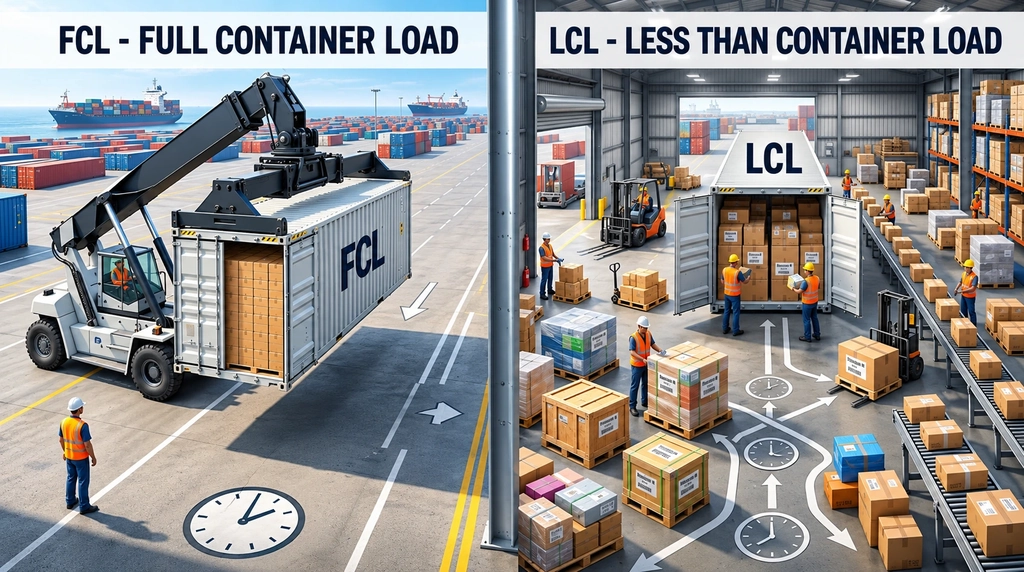
Your LCL might be on the same vessel as someone else’s FCL, so why does it take so much longer to reach its final destination? It’s a common pain point for supply chain managers and importers to see their shipment arrive on time at the port but still not be available for some days afterwards.
The difference isn’t the ocean, but the extra steps involved in pre-vessel and post-vessel handling.
Simply put, Full Container Load (FCL) freight means one shipper’s cargo moves in one dedicated container, whereas Less than Container Load (LCL) freight means multiple shippers’ cargoes share container space. Therefore, LCL requires specialized LCL consolidation and deconsolidation. If you are asking, “Why does LCL shipping take longer than FCL in total transit time?” The answer is that LCL incurs extra coordination steps.
Why Does LCL Shipping Take Longer Than FCL?
LCL shipping generally takes longer than FCL because of the extra consolidation, handling, sorting, stuffing, deconsolidation, and release stages that LCL incurs to combine and separate multiple shippers’ cargo into one shared container, unlike moving as a single dedicated container from supplier to port.
For example, while FCL moves straight to the vessel, LCL requires the use of third-party facilities to merge and split the freight, which adds time to the shipment timeline.
LCL vs FCL: What Happens to Your Cargo Before It Reaches the Vessel?
To understand the time difference, let’s take a look at the origin-side operations for both shipping methods.
What happens with FCL?
An FCL has a very streamlined process.
Cargo → Container Loading/Stuffing (at shipper’s facilities) → Container Movement → Port → Vessel
Since the container is dedicated to a single shipper, it can be loaded, sealed, and moved directly to await vessel loading at the port.
What happens with LCL
LCL cargo from multiple shippers needs to be combined and consolidated before it can be loaded aboard the vessel. The process is generally like this:
Cargo → CFS Receiving → Documentation/Verification → Consolidation → Container Stuffing → Port → Vessel
Depending on the service and route, your cargo must arrive at a designated facility days before the port cut-off so the logistics provider has time to consolidate the shared container for safety and proper packing.
Shipping LCL? These Extra Handling Stages Can Add Time
Every time cargo is physically touched or transferred, it takes time. Here are some key stages that influence LCL shipping times.
Cargo Receiving at the CFS
LCL cargo is generally received at a Container Freight Station (CFS) or a consolidation warehouse. Upon arrival, cargo isn’t immediately placed into a container. It must first be received, documented, weighed, and measured (if applicable) before it’s placed into the consolidated container.
Consolidating Cargo from Multiple Shippers
Cargo from multiple shippers must be consolidated carefully to maximize space and safety. This introduces coordination that isn’t normally required when one shipper fills a container. Planners must ensure that shipments are heading to the same destination port and can be safely stored together.
Container Stuffing
Once consolidation is planned, the cargo must be arranged/placed inside the container in an organized manner. The process depends heavily on dimensions, weight, packaging, safety (hazardous material, general goods), and loading sequence.
Deconsolidation at Destination
This is a common point where LCL gets stuck on the ship because LCL shipments experience extra days in transit. Once the consolidated box arrives at the destination port, it must be moved to a destination CFS, where the container is unsealed and opened, and the individual shipments are physically separated.
Cargo Sorting and Individual Release
Once deconsolidated, shipments need to be identified, sorted, and processed for each recipient. Your cargo will be released when customs clearance is completed, and destination handling fees are settled. This individual cargo release introduces added handling compared with a dedicated FCL container that simply rolls out of the port on a truck.
Does LCL Actually Take Longer at Sea?
No, the time at sea isn’t longer simply because a shipment is LCL.
If your LCL cargo and someone else’s FCL cargo are loaded on the exact same vessel from Nhava Sheva to Rotterdam, your container will spend exactly that much time at sea.
It’s important to differentiate between Ocean Transit and Lead Time. The difference in total elapsed time comes entirely from additional origin and destination handling.
How Much Extra Time Can LCL Handling Add?
There is no universal figure for the extra days LCL consolidation adds. It depends on multiple moving parts:
- Origin and Destination CFS Efficiency: How quickly the warehouses can process freight
- Trade Lane: High-volume lanes have frequent consolidation. Niche lanes may have to schedule for the next opportunity
- Consolidation Schedule & Cut-off Times: Missing a weekly cut-off may delay a shipment by a week
- Customs Processes: LCL container with other shipments can sometimes slow the deconsolidation.
Shippers should generally plan to add 3-7 days extra on either side of the ocean voyage to account for CFS handling, stuffing, and deconsolidation (varies by route/carrier schedule). Always distinguish between carrier sailing schedule and your end-to-end LCL shipment timeline.
What Other Factors Can Delay an LCL Shipment?
While consolidation is the main cause of LCL taking longer, other factors can also disrupt the timeline. Not every delay is caused by the LCL process!
- Documentation Issues: Incomplete or wrong documents (Bill of Lading, Commercial Invoice)
- Cargo Readiness: Wrong or delayed cargo (must be ready before CFS consolidation cut-off)
- CFS Cut-Offs: Missing a CFS receiving or consolidation cut-off delays the planned shipment.
- Customs Clearance: Stricter cargo clearance timelines
- Port Congestion: Vessels getting delayed, strikes, etc. will affect ships equally – LCL and FCL alike
- Multiple Consignments: Because LCL involves multiple shipments, this is also a coordination issue. Hazardous cargo paperwork being flagged may occasionally slow the move of the box.
- Destination Handling: Deconsolidation and individual cargo release add time after vessel arrival.
LCL or FCL? Which One Makes More Sense for Your Shipment?
Understanding the issue with LCL taking longer than FCL can help you understand why you make the decision to use one or the other. It boils down to your shipment size, schedule, and cost considerations.
LCL could be a better option when:
- Your cargo volume (CBM) is too small to justify an FCL
- Your cargo isn’t time-critical (you have buffer days)
- Buying an FCL just to carry your goods isn’t cost-efficient
- You intend to utilize shared container space in a way to move lean inventory
FCL could make more sense when:
- Your cargo can efficiently fit inside 20/40ft container
- Fast handling and minimally touched shipment is a priority
- Security and separation (special goods requirement) favors a dedicated container
- Freight economics dictate that it is cheaper to buy a full container than to move LCL
Want to Reduce Avoidable LCL Delays? Prepare These Things Early
While you cannot avoid the physical time it takes to consolidate a cargo, you can avoid other unnecessary delays. We recommend that shippers:
- Know when your cargo is available ahead of the consolidation cut-off
- Have accurate documentation that perfectly coincides with the cargo to avoid customs hold
- Have accurate cargo measurements and weight so that CFS can stuff the container efficiently
- Know if your packaging is adequate to go through multiple handling stages (palletized preferred)
- Know deadlines at CFS receiving and factor in inland transportation
- Coordinate customs documentation early with your broker
- Have realistic buffer time in your schedule
Need Help Managing Your LCL Shipment?
Navigating the intricacies of LCL Freight and Sea Freight demands an experienced logistics partner who knows how to reduce delays at every touchpoint.
Total Transport is your logistics partner in India, offering complete Import/Export Logistics and Consolidation Services, including consolidation coordination, CFS-related handling, rigorous documentation coordination, and complete inland transportation. From reliable Freight Forwarding for your small LCL consignment to a dedicated FCL Freight solution, we have you covered.
Contact Total Transport to check LCL consolidation schedules or for a freight quotation.
FAQ (Frequently Asked Questions)
- Why does LCL shipping take longer than FCL?
LCL shipping involves additional operations, including receiving cargo at a Container Freight Station (CFS), grouping multiple shipments, and physically sorting the cargo after arrival. FCL doesn’t require any of these.
- Is LCL always slower than FCL?
In terms of total end-to-end lead time, LCL is generally slower due to additional origin and destination handling. However, the time at sea for LCL is exactly the same as FCL if they are on the same vessel. - Does LCL take longer at sea than FCL?No. Ocean transit time is determined by the vessel’s routing and speed. Since LCL and FCL share a common vessel, they arrive at the destination at the same time.
- What is LCL consolidation?
LCL consolidation is the process of putting together multiple smaller shipments into a shipping container. The consolidation is generally done at a CFS (Container Freight Station).
- Why does LCL require deconsolidation?
Because an LCL container carries many different consignments from different consignees, it can’t be delivered to one address. It needs to first be taken to a CFS, where the container is opened, and shipments are pulled out.
- How can I reduce delays experienced in LCL shipping?
You can reduce delays by providing accurate documentation, reporting your cargo weight and dimensions correctly, ensuring your goods are palletized, and delivering your cargo on time at CFS facilities ahead of consolidation cut-off deadlines.
- When should I use FCL instead of LCL?
You should choose FCL when your shipment volume can be efficiently placed inside a 20/40ft container, when your delivery schedule prohibits CFS handling, and when your cargo requires a dedicated container environment.

Recent Comments