


Why Can a Light Air Shipment Still Have a High Freight Cost?
If your shipment’s physical dimensions occupy significantly more aircraft hold volume than the same cargo’s gross weight. A light, bulky shipment takes up considerable aircraft hold volume, and the airline may charge extra for this.
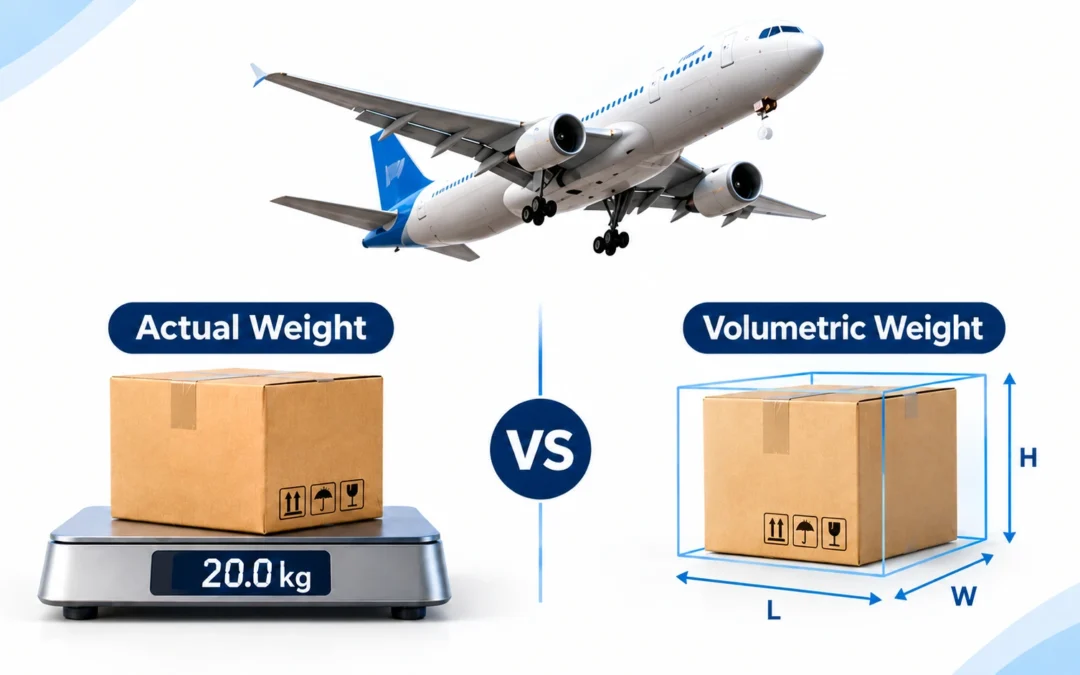
Understanding chargeable weight calculations for air freight is critical for optimised budgeting. Chargeable weight compares your cargo’s actual/gross weight (scale weight) against its volumetric weight (space it occupies) and selects the higher of the two for final billing.
This guide walks through the calculation process, how packing choices impact charges, and offers actionable insights for cost optimisation.
What Is Air Freight Chargeable Weight?
Chargeable weight is simply the quantified weight for levying freight charges as determined by the applicable airfreight rating rules.
In most cases, it will represent the higher of the two options: actual/gross weight of your cargo or its volumetric equivalent. Understanding why airfreight uses both physical and volumetric weight is critical. An aircraft’s capacity is a combination of its maximum allowable payload (weight) and hold volume. Charging only for scale weight would see a flight departing with a fully packed hold but with the value of its cargo being extremely low. For example, a massive container of cotton wool would occupy an entire aircraft hold but would only weigh a few tonnes. The carrier would receive little compensation for the space taken up by such cargo. The airline compensates itself for such shipments by using the concept of volumetric weight.
Actual Weight Vs Volumetric Weight: Understanding the Difference
Understanding the concept of air freight chargeable weight necessitates an introduction to two concepts:
|
Factor |
Actual/Gross Weight |
Volumetric Weight |
|
Meaning |
Physical weight of the shipment |
Weight calculated based on shipment’s dimensions |
|
Based on |
Scale measurement |
Length × Width × Height |
|
Relevant for |
Dense/heavier cargo |
Lightweight and bulky cargo |
|
Changes with packaging dimensions |
Not directly |
Yes |
|
Represents |
Physical mass |
Space occupied for rating purposes |
How Is Volumetric Weight Calculated In Air Freight?
Volumetric weight calculation involves converting a shipment’s dimensions into an equivalent weight using an applicable dimensional factor. This formula is used:
Volumetric weight = (Length × Width × Height) ÷ Applicable dimensional factor
Volumetric weight calculation typically involves the following steps:
- Measure the final packed shipment (i.e., its outer dimensions).
- Measure its length, width, and height.
- Ensure measurements are in the same units (commonly centimetres for international air freight).
- Multiply all three values together to get the volume.
- Divide the resulting volume by the applicable dimensional factor.
- Compare this value to the actual/gross weight.
- Finally, apply the higher of the two values as the applicable chargeable weight.
Note: 6000 cm³/kg is commonly used as the dimensional factor applicable to international air freight. However, the factor can vary across airlines and for different trade lanes, couriers, or services. Always confirm it with your logistics partner.
Why Is Chargeable Weight Higher Than Actual Weight?
Aircraft have limitations in both weight and volume. A shipment of delicate foam items may only weigh 50 kg but occupy 3 cubic metres of space. If the carrier charged only the actual weight, they would lose out on the ability to utilise the available space and generate revenue.
Volumetric weight calculations reflect how much space a shipment occupies relative to its actual weight. If bulky packaging causes a shipment’s volumetric weight to exceed its actual weight, the carrier will levy a charge based on the former, and the chargeable weight will exceed the actual weight.
How Do You Calculate Air Freight Chargeable Weight Step by Step
The following steps can be taken to calculate chargeable weight:
Step 1: Determine the actual/gross weight of your shipment
Weigh your shipment on a scale according to the applicable carrier/rating rules.
Step 2: Measure the shipment’s dimensions
Measure your shipment’s length, width, and height in its final packed state, including pallets/crates.
Step 3: Determine the shipment’s volumetric weight
Use the volumetric weight calculation method as above and the dimensional factor applicable to your shipment, carrier, or trade lane. If you are unsure of the applicable factor, ask your logistics partner.
Step 4: Compare the two weights
Compare the actual/gross and volumetric weights.
Step 5: Determine the applicable chargeable weight
According to the applicable rules, apply either the actual or volumetric weight as the chargeable weight. In some situations, the higher of the two weights applies.
Step 6: Apply the applicable rate to arrive at your freight charges
Multiply the rate (in kg) quoted by the carrier or logistics partner by the applicable chargeable weight to estimate your core air freight charges.
Air Freight Chargeable Weight Example: Actual Weight vs Volumetric Weight
Let us look at a few examples for a better understanding.
Example 1 – Dense Cargo:
- Cargo: 1 box of machine parts
- Dimensions: 50cm x 40cm x 40 cm
- Actual/gross weight: 35 kg
- Dimensional factor: 6000cm3/kg
- Volumetric: (50x40x40) ÷ 6000 = 13.33 kg = 13.33kg
Example 2 – Bulky Cargo:
- Cargo: 1 box of winter jackets
- Dimensions: 80cm x 60cm x 60 cm
- Actual/gross weight: 15kg
- Dimensional factor: 6000cm3/kg
- Volumetric: (80x60x60) ÷ 6000 = 48 kg = 48kg
Example 3 – Multiple Carton:
Say a business wants to ship 3 boxes with dimensions 40cm x 30cm x 30cm each and a gross weight of 20kg each. Which rule applies?
Some carriers calculate the volumetric weight of each piece and compare it to its actual weight, where each piece would have a volumetric weight of 60kg, higher than 20 kg. Other carriers will calculate the volumetric weight of the entire shipment and compare that to the actual weight (volumetric weight: 40×30×30×3=108,000cm3, 18kg – higher than 60kg). Your logistics partner will apply the applicable methodology.
What Happens When Actual Weight and Volumetric Weight Differ?
When you compare the two weights, you will find that there are three scenarios:
When Actual Weight > Volumetric Weight:
Your goods are dense (like steel tools). You will be charged on the actual weight.
When Volumetric Weight> Actual Weight:
Your goods are bulky compared to their density (like bubble wrap or apparel). You will be charged on the volumetric weight.
When Both Are Similar:
You are charged on whichever is slightly higher.
How Does Packaging Affect Air Freight Chargeable Weight?
Packaging decisions directly impact your air freight chargeable weight. If you pack a small box in a large carton, you will be charged for the large carton. Volumetric weight calculations penalise loose packing and oversized cartons.
Businesses can reduce their volumetric weight by optimising packaging. Pack your goods safely, but with minimal space around them. Finally, consider consolidating cartons where feasible and safe.
How Can Businesses Reduce Avoidable Air Freight Costs?
Businesses can reduce avoidable air freight costs by eliminating unnecessary space in their packaging. There are several ways for businesses to do that:
- Measure the actual packed weight and dimensions of your shipment (not just the product itself).
- Avoid oversized cartons – use appropriately sized ones to eliminate space.
- Consolidate cartons where practical and safe.
- Provide accurate dimensions when obtaining quotes to avoid revisions later.
- Find out what the dimensional factor is that your carrier or logistics partner will use for your shipment.
- Ask about minimum chargeable weight (where a certain weight applies even if your shipment is smaller).
- Compare quotes based on total cost rather than just the rate per kg.
- Ensure quotes cover all costs (including origin and destination costs).
- Ensure the scope of service applies to your needs.
What Information Should You Provide to Get an Accurate Air Freight Quote?
To obtain an accurate quote, make sure that the following information is shared with your logistics partner:
- Origin and destination addresses.
- Number of packages.
- Each package’s dimensions (L x W x H).
- Each package’s actual/gross weight and total.
- Description of cargo and type of commodity.
- Service requested (standard, express, deferred, etc.).
- Any special requirements (dangerous goods, temperature-controlled, etc.).
- Any pickup/delivery requirements.
- Any other information the logistics partner may request.
Why Should You Always Check the Chargeable Weight Before Shipping?
Calculating your chargeable weight helps to plan your logistics budget better. It also allows you to negotiate with suppliers and ensures you don’t get billed for a higher weight than expected. It enables procurement teams to make informed packaging decisions. Finally, it allows you to compare quotes accurately.
Air Freight Chargeable Weight Guide: What Should Indian Importers and Exporters Check?
Indian businesses engaged in import and export should ensure they understand their quotation. When presented with a quotation, Indian importers and exporters should double-check the following:
- That the quotation specifies the chargeable weight.
- That the actual/gross weight and dimensions they provided were used for the quotation.
- The dimensional factor that was used (e.g., 6000cm3/kg, 5000cm3/kg etc.).
- That there are no minimum chargeable weights applicable to their trade lane.
- That origin charges (such as X-ray screening or Mumbai or Delhi terminal charges) and destination charges have been included.
- That fuel, security, or other airline levies have been added.
- That local pickup/delivery and customs clearance charges are included or excluded.
How Total Transport Can Help With Air Freight Planning
Total Transport can help Indian importers and exporters better understand their air freight costs. We assist businesses in coordinating quotations, documentation, as well as overall import/export logistics management. By analysing a shipment’s specific needs, we can ensure that your air freight requirements are planned to avoid unexpected costs at the terminal.
FAQs (Frequently Asked Questions)
- What is air freight chargeable weight?
It refers to the weight basis on which a business is charged for shipping a package. It is generally based on the higher of a shipment’s actual (gross) weight and its volumetric weight. - How do I calculate chargeable weight in air freight?
You do this by comparing a shipment’s actual (gross) weight to its volumetric weight and applying the higher of the two. - What is the difference between actual and volumetric weight?
Actual weight is the actual mass of a shipment, whereas volumetric weight refers to its equivalent volume. - How do I calculate volumetric weight?
Multiply a shipment’s length, width, and height and divide it by the applicable dimensional factor. - Why can volumetric weight be higher than actual weight?
Because a shipment occupies space inside an aircraft regardless of its actual weight. - Is air freight charged on actual or volumetric weight?
It is generally charged based on the higher of a shipment’s actual weight and its volumetric weight. - How can I reduce volumetric weight?
You can do that by reducing the dimensions of your shipment. This can be done by avoiding oversized cartons and ensuring goods are packed in a way that minimises space. - What data do I need to calculate air freight charges?
The origin and destination, number of packages, each package’s dimensions (L x W x H), each package’s actual/gross weight and total, description of the commodity, and service level.

Recent Comments