


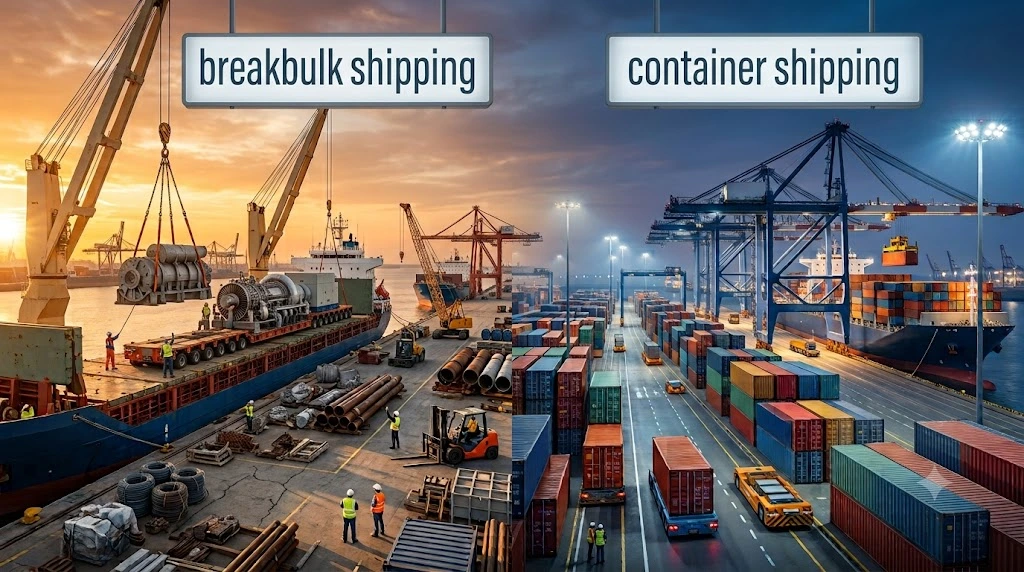
When it comes to international ocean freight, one of the most important decisions supply chain planners make is choosing between breakbulk and container shipping. Choosing the most efficient way to move your freight from point A to point B isn’t always straightforward.
The type of cargo you need to ship plays an important role in deciding: its size, weight, dimensions, quantity, and packaging. The physical attributes of your goods, specialized handling, origin/destination, and schedule requirements will also help you determine whether breakbulk or container shipping makes more logistical and economic sense.
This guide breaks down the operational differences to help you select the exact right fit for your cargo profile.
Shipping International Cargo? First, Understand Breakbulk and Container Shipping
Before comparing the two methods, clearly define how each operational model functions within the global supply chain.
What Is Breakbulk Shipping?
Breakbulk shipping is a type of ocean freight where cargo is broken into individual items or pieces and consolidated into standardized intermodal containers. This type of ocean shipping is typically used for goods that have to be loaded on board individually.
Suitable cargo categories for breakbulk often include:
- Large industrial machinery
- Oversized manufacturing components
- Structural steel products
- Project cargo
- Certain heavy or unusually shaped infrastructure equipment
While oversized items typically utilize the breakbulk shipping method, it might not always be the case. Breakbulk means the goods are broken up, loaded on board individually, and then stowed separately.
What is Container Shipping?
Container shipping typically refers to shipping goods that are packed and stowed within standardized shipping containers. (20-foot, 40-foot, or specialized variations like open-top or flat-rack containers).
For businesses moving standard goods, container shipping utilizes two main formats:
- FCL (Full Container Load): A single shipper utilizes the entire space of the container.
- LCL (Less than Container Load): Multiple shippers share space in a single container for smaller cargo volumes.
For standard goods, container shipping tends to have a more standardized, uniform, and streamlined process.
Breakbulk vs Container Shipping: What Really Changes for Your Cargo?
Understanding the main differences helps you understand what sets these two methods of shipping apart.
Below is a breakdown of the main differences between breakbulk and container shipping.
Breakbulk Shipping vs. Container Shipping
|
Factor |
Breakbulk Shipping |
Container Shipping |
|
Cargo Format |
Individual items or pieces. |
Stowed within shipping containers. |
|
Typical Cargo |
Oversized, heavy, long, irregular, or project cargo. |
Packaged goods and cargo that can easily fit in a box. |
|
Packaging |
Can vary depending on requirements. |
Typically designed for maximizing container utilization. |
|
Handling |
Typically involves cranes and other lifting equipment. |
Standardized container handling (gantry cranes, reach stackers). |
|
Equipment |
Customized to the cargo needs. |
Typically standard across all ports and terminals. |
|
Space Utilization |
Typically utilized for items that don’t fit within a container. |
Typically maximized for standard or specialized containers. |
|
Protection |
Depends on cargo-specific packaging (shrink wrap, crating) and stowage plans. |
The container itself provides an enclosed, standardized transport environment. |
|
Scheduling |
Often depends on the availability of specialized ships and arrangements. |
Generally utilizes regularly scheduled services. |
|
Best Suited For |
Goods that cannot be packaged or are too big or unwieldy. |
Goods that can be packed within a container. |
Questions to Ask a Logistics Company Before Signing a Contract
When it comes to oversized or heavy cargo, breakbulk is the most sensible solution. You should consider breakbulk shipping services if your freight has any of the following characteristics:
- When the shipment’s length, width, and height can’t fit within any type of standard or specialized container.
- When the shipment’s weight is too concentrated to be distributed within the weight limits of a container.
- Cargo that can’t be disassembled without damaging machinery/equipment.
- Heavy project cargo that requires customized or specialized lifting equipment.
Keep in mind that utilizing breakbulk depends on the type of vessels, cranes, and overall lifting equipment available, as well as the overall route and stowage plan.
Can Your Cargo Fit a Container? Here’s When Container Shipping Makes More Sense
For many international shippers, container shipping is the go-to option. For standard goods, container shipping usually presents shippers with a more streamlined and straightforward method.
You should consider container shipping if your goods:
- Have standard dimensions that fit easily within a 20ft or 40ft container with no weight limitations.
- Are packaged commercial goods that can be easily packed in a box.
- Can be efficiently packed, palletized, or slip-sheated to maximize the space utilization within a container.
- Have high demand and require frequent shipments.
- Require a standard multimodal approach which involves trucking, rail, and/or barge without the need for additional packing/unpacking.
Is Breakbulk More Expensive Than Container Shipping?
Perhaps one of the most frequent questions logistics managers ask is whether breakbulk is more expensive than container shipping. There isn’t a definitive answer because of the multiple variables to consider.
Keep in mind that the cheapest quote is not necessarily the most cost-effective option when you factor in other expenses. The total cost of your shipment depends heavily on:
- Cargo dimensions and weight: Heavy and oversized cargo typically utilize different pricing brackets.
- Port handling and equipment: Breakbulk shipping will typically involve higher costs at the port due to equipment requirements.
- Vessel and container availability: This can affect costs depending on the demand.
- Cargo preparation: In some cases, disassembling machinery or equipment, paying for specialized flat-rack containers, and assembling the equipment at the destination may end up costing more than breakbulk shipping.
- Inland transportation: Breakbulk cargo by road typically requires special permits, police escorts, and/or multiple-axle trailers.
Keep in mind that the actual costs of your breakbulk or container shipping depend on the total costs of the door-to-door shipment as well as any additional equipment, preparation, and/or permit fees.
Concerned About Cargo Handling and Damage? Compare the Two Options Carefully
Both methods of shipping have their own strengths and weaknesses when it comes to protecting the goods. As far as safety is concerned, remember that neither method is necessarily safer than the other. It all comes down to individual preparation and execution.
|
Factor |
Breakbulk Shipping |
Container Shipping |
|
Cargo Protection |
Good handling practices are essential since individual items will need to be lifted and loaded on board. |
An enclosed environment reduces risks unless individual items are damaged or improperly loaded. |
|
Specifics of Handling |
Very specialized cranes and equipment are utilized for breakbulk shipping. |
Standard gantry cranes are typically utilized for container shipping. |
|
Risk of Damage |
Possible risks involve improper utilization of slings, individual lifting equipment, and/or exposure to the elements. |
Risks involve improper lashing, exposure to the elements, or mishandling within the container. |
What Cargo Characteristics Should You Check Before Choosing?
Before requesting freight quotes, evaluate your cargo against this practical logistics checklist:
- Cargo Dimensions: Does it fit inside a shipping container?
- Cargo Weight: Does it exceed the shipping container’s weight limit?
- Cargo Quantity: How many individual items or units do you have to ship?
- Cargo Shape: Is the cargo uniformly shaped or highly irregular, which makes it difficult to stow inside a box?
- Packaging: Can it be securely packed, lashed, and/or palletized in a box?
- Cargo Handling: Does it require special cranes, equipment, or handling?
- Origin and Destination Ports: Do they have the lifting equipment needed to handle your cargo?
- Inland Transportation: Can it fit on the road between the port and the final destination?
- Delivery Schedule: Does your project timeline make one method more viable than the other?
Breakbulk or Container Shipping: A Decision Framework
Use the decision framework below as a helpful tool when it comes to understanding the options before you.
Consider breakbulk shipping if:
- The cargo cannot practically or economically fit within a shipping container.
- The shipment involves unusually heavy or oversized items.
- Specialized lifting equipment is required.
- Project cargo schedules allow for individual item handling as opposed to standard methods.
Consider container shipping if:
- The cargo fits within standard size and weight limitations.
- The goods can be packed, palletized, and/or secured within a box.
- The origin and destination ports are made for standard handling.
- The shipment requires regular, frequently scheduled standard services.
Keep in mind that if your cargo falls in between, you will need to consider both options based on the total cost of the door-to-door logistics, handling requirements, and availability of ports and equipment.
Need Help Choosing the Right Shipping Method for Your Cargo?
Choosing between breakbulk and container shipping can be a complex process. If you deal with any type of specialized or heavy cargo on a regular basis, you are likely to benefit from professional freight planning before you decide on a shipping method.
At Total Transport, we specialize in facilitating door-to-door logistics management for our clients. Whether you require standard FCL/LCL ocean freight, breakbulk shipping, or specialized project cargo handling, our professionals consider all relevant variables to determine the most efficient way to ship your cargo.
From inland transportation to port handling and ocean freight, Total Transport always helps you find the most efficient solution for your supply chain.
FAQ (Frequently Asked Questions)
- What is the difference between breakbulk and container shipping?
Breakbulk shipping deals in separate items that require individual handling. Container shipping deals in goods packed in standardized containers. - What type of goods are typically shipped using breakbulk shipping?
Large industrial machinery, oversized manufacturing parts, structural steel, and project cargo. - Is breakbulk shipping cheaper than container shipping?
It depends on various factors.
Breakbulk shipping can have higher port handling costs. However, for project cargo or large items, it may be more economical to pay for equipment and use breakbulk shipping instead of dismantling, packing, and reinstalling items later.
- Can oversized cargo be shipped in containers?
It depends on the dimensions, weight, and equipment availability. Simply, yes, certain oversized cargo can be shipped using specialized container equipment. - Is breakbulk shipping safer than container shipping?
Neither method is inherently safer than the other. In both cases, the likelihood of damage depends on proper packaging, lashing, and handling. - How do I choose between breakbulk and container shipping?
You have to make a breakbulk vs. container shipping decision based on the characteristics of your goods, origin/destination, handling requirements, and costs associated with either method.
- What affects the costs of breakbulk shipping?
The cost of breakbulk shipping depends on the dimensions and weight of the cargo, port handling and equipment, customized packaging, vessel availability, and additional inland transportation costs.

Recent Comments